
The deal would allow Japan to export nuclear technology to India, making it the first non-NPT signatory to have such a deal with Tokyo. It would also cement the bilateral economic and security ties as the two countries warm up to counter an assertive China.

In a major breakthrough in its quest for nuclear technology, India will launch talks with Japan from Monday to seal a civilian atomic cooperation pact that will pave the way for the sale of advanced technology by Japanese firms like Mitsubishi and Hitachi. Terming the development as 'very positive', sources said for Japan, the only country ever attacked with atomic weapons, the decision to go ahead with such a pact with a non-Nuclear Non-Proliferation Treaty signatory country
India will next Monday sign a key safeguards agreement with the International Atomic Energy Agency to allow supply of atomic fuel and technology to the country moving a step closer to operationalising its international civil nuclear cooperation after the 34-year-old nuke trade embargo was lifted.
Indicating a greater role of the private sector in the field of nuclear energy, Prime Minister Narendra Modi said there was a need to tap additional sources of investments for the ambitious expansion programme.
The chairman of India's Atomic Energy Commission makes a case for nuclear energy saying all other forms of power gerenration will not be able to meet the country's staggering demand.

Air India sale will give a boost to India's privatisation drive, the Economic Survey said on Monday, as it suggested redefining the public sector role in business enterprises to encourage private participation in all sectors. The government earlier this month handed over ownership rights in national carrier Air India to Tata Group for Rs 18,000 crore. The amount includes the takeover of the debt burden of Rs 15,300 crore and another Rs 2,700 crore in cash.

The only thing that may salvage Narendra Modi's trip to the US is his meetings with CEOs, such as those of Blackstone, First Solar, Qualcomm, Adobe, and General Atomics, asserts Rajeev Srinivasan.
Indore-based Raja Ramanna Centre for Advanced Technology, a Department of Atomic Energy facility, has played a major role in the supply of vital parts for Large Hadron Collider of European Organisation for Nuclear Research.
India on Monday signed a key safeguards agreement with the International Atomic Energy Agency to allow inspection of additional civilian reactors, clearing the decks for supply of atomic fuel and technology by the international community after a 34-year-old nuke trade embargo was lifted last year.
Asserting that the Kudankulam Nuclear Power Plant belonged to the "highest safety category" of plants currently in operation in the world, the Centre on Tuesday sought dismissal of petitions in the Madras high court against the Rs 14,000 crore Indo-Russian project.
The much-awaited Advanced Heavy Water Reactor may be the first reactor to come up in populated areas like the Bhabha Atomic Research Centre.

Nehru's faith in science and technology, his genuine respect for Bhabha, and their burning ambition worked synergistically to place India on the nuclear map of the world. Atomic energy developed and prospered because of Nehru's vision fulfilled by Bhabha's mission, recalls K S Parthasarathy, former secretary of the Atomic Energy Regulatory Board, on the occasion of India's first prime minister's 119th birthday today.

Prime Minister Narendra Modi on Wednesday called for focus on 'repair and prepare' as the nation emerges out of a devastating pandemic. "Over the past year, we have witnessed a lot of disruption in different sectors. Much of it is still there. Yet, disruption does not have to mean despair," he said at VivaTech Summit. "Instead, we must keep the focus on the twin foundations of repair and prepare," he said referring to the need to augment healthcare infrastructure in the country as well as prop up the economy.

On Dr Homi J Bhabha's 110th birth anniversary, Dr K S Parthasarathy shares some personal memories of the legendary nuclear scientist.

The navy is pushing hard for IAC-2 to be a 65,000-tonne, flat deck carrier that is designed and built in India, with technical and tactical consultation from the US navy -- the global masters in aircraft carrier operations.

Fifteen Cabinet ministers and 28 Ministers of State were sworn-in by President Ram Nath Kovind at a ceremony at Rashtrapati Bhavan on Wednesday evening.

The two PMs may also explore ways to further deepen ties between the navies of the two countries to check China's heightened activities in the Indian Ocean.
Even though India has major strengths in chip design and in making the software that actually commands the processors to execute specific tasks, chip-manufacturing has never been the country's strength.
Science and Technology Minister Prithviraj Chavan, who is in-charge of Department of Atomic Energy, said the country lacks a law under which compensation could be awarded in the case of a nuclear accident.
Prime Minister Narendra Modi on Thursday is scheduled to have as many as eight meetings, including with Vice President Kamala Harris, on the first working day of his current US trip.

The deal, estimated to be worth USD 2 to 3 billion, has been approved by the state department, the sources said.
On the 20th anniversary of the first flight of the Tejas, we must congratulate the entire team who made sure that the LCA flew and returned safely on January 4, 2001, sowing the seed for development of a state-of-the-art fighter airplane that our country so badly needed, says IAF veteran Air Commodore Nitin Sathe.

London hopes to convince New Delhi's naval planners to power India's second indigenous aircraft carrier with the Queen Elizabeth's integrated all-electric propulsion system.
India has made major scientific and technological contribution to this new atom smasher also called the Large Hadron Collider. LHC is expected to answer several facts of fundamental nature of the universe that remains a mystery, said the scientists of Tata Institute of Fundamental Research.

The start of BHIM's declining share coincided with the launch of Google Tez in mid-Septem

The reopening of schools and colleges has sparked a crisis in the edtech sector with falling valuations, slowing funding rounds and faltering investor sentiment. In a totally altered, post-pandemic landscape where students are back at school and colleges, companies are scrambling to revert to bricks-and-mortar tuition centres and adopting a hybrid model of offline and online education. Demand for online tuition has fallen, affecting the revenue of edtech companies in recent months. After two years of booming revenues, some experts say the sector is looking at a possible meltdown.
'We have not done anything different than these six nuclear powers of today did, to attain nuclear capabilities. Why then we are being discriminated, when we bought all the supplies from these western companies and followed the same strategy to achieve the same nuclear capability like these six nuclear nations,' he asked during an interview with The News.

Modi's critics will say that he has put up cement and steel structures, but weakened the institutions of governance whereas Nehru strengthened them, observes T N Ninan.

'Today, I am taking new actions to restrict Iran's nuclear, ballistic missile, and conventional weapons pursuits. My Administration will never allow Iran to have a nuclear weapon, nor will we allow Iran to endanger the rest of the world with a fresh supply of ballistic missiles and conventional arms,' Trump said in a statement.

If international crude oil prices zoom past the current level of about $90 per barrel and move towards $100 and beyond, middle-class consumers are not going to keep quiet about their discomfort, points out Arun Balakrishnan, former chairman and managing director, Hindustan Petroleum.
The Act will allow the two countries to share civilian nuclear technology and bring India's civilian nuclear program under the safeguards of the International Atomic Energy Agency.
'The nation, at this critical juncture, depends on its representatives in Parliament to ensure that decisions taken today do not inhibit our future ability to develop and pursue nuclear technologies for the benefit of the nation'
They said that India and the US should put on a fast track the negotiations with the Nuclear Suppliers' Group and the International Atomic Energy Agency and pave the way for signing the pact.
Dr Kakodkar's strategic stubbornness ultimately got India what it wanted though the negotiations with the US went to the wire, notes Shivanand Kanavi.
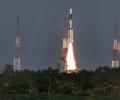
'Others will think twice before attacking our space assets.'

'Mortality or hospitalisation has not increased in South Africa because of the new variant.' 'There is nothing to show so far that it is more infectious.' 'I am of the opinion that at the moment, there is no reason to panic.'
"If we remain dependent on foreign technologies, we can never become world leaders and we cannot survive the global competition unless we achieve global leadership at least in some areas where we have strength," Kakodkar said at the convocation of Pt Ravi Shankar Shukla University in Raipur.
In the years to come, nanotechnology is expected to usher the next technological revolution having deep impact on the economy and society in the 21st century.
